

Countdown to Summer
9

Focus on women
6

Mediation
6
German
Filters
Worksheets
Letters to my future self
Learners reflect on their current life situation, their wishes and goals, and formulate these in a letter to their future selves in order to create awareness of their own development.
Contents and methods:
The worksheet provides structured guidance on writing a personal letter to one's future self. Guiding questions serve as inspiration. The method is supplemented by the creation of a time capsule, in which small personal items such as photos or notes are enclosed with the letter.
Skills:
- Self-reflection and introspection
- Formulation of personal and professional goals
- Creative and written expression
Target group and level:
Grade 5 and above
Films in the classroom: Brochure
With the help of the worksheet, learners engage with a film in a structured way in order to develop a deeper understanding and to reflect on and transfer what they have seen.
Contents and methods:
The worksheet is structured like a brochure and asks questions about the content and further questions about the film. The worksheet ends with a personal evaluation of the film.
Skills:
- Concentrated extraction of information from a visual medium
- Analysis, reflection and transfer of film content
Target group and level:
Grade 7 and above
Films in the classroom
With the help of the worksheet, learners engage with the content of a film in a structured manner before, during and after viewing it in order to develop a deeper understanding and to reflect on and transfer what they have seen.
Content and methods:
The worksheet begins by testing prior knowledge of the film. While watching, the pupils complete multiple-choice tasks to actively engage with and consolidate their understanding. After the film, transfer tasks are used for further processing and reflection on the topic.
Skills:
- Activating and building on prior knowledge
- Concentrated extraction of information from a visual medium
- Analysis, reflection and transfer of film content
Target group and level:
Grade 7 and above
Debate training – Active listening
Students learn and practise active listening skills in order to engage in constructive and respectful debate. They reflect on the importance of this skill for exchanging arguments and promoting mutual understanding.
Contents and methods:
The worksheet introduces the basics of active listening and illustrates its importance in debates and everyday life. Using a mini-debate on a selected topic, pupils practise listening attentively to arguments, summarising them and building on them. They use predefined sentence starters to create a flowing dialogue.
Skills:
- Active listening and empathy
- Ability to argue and change perspectives
- Reflection and self-awareness
- Structured documentation of arguments
Target group and level:
Grade 7 and above
Vocabulary Trainer German - C1
The main learning goal of this worksheet is to expand and deepen the advanced German vocabulary of students and learners at the C1 level. This will be achieved by introducing and actively using 10 specific German words, with their meanings inferred from descriptions and practiced in various contexts.
Content and Methods: The focus is on 10 advanced German words, with their meanings described in German. The methods are diverse: vocabulary discovery (deriving the English meaning from the German description), productive language use (writing a text of about 200 words using all the vocabulary), the "Taboo" game to describe the words without using certain key terms, and a final knowledge check by matching the German words with their English counterparts.
Skills:
- Linguistic Skills (German): Expanding advanced vocabulary (C1)
- Reading Comprehension: Inferring word meanings from context and description
- Written Expression: Creative and coherent composition of a longer text
- Communicative Skills: Explaining complex terms without using synonyms (Taboo game)
- Cognitive Flexibility: Mapping and transferring vocabulary between English and German
Target Group and Level: Learners of German at the C1 level (advanced language use)
Note: The speaking exercise can only be performed in the Chrome browser.
Vocabulary Trainer German - C2
The primary learning goal of this worksheet is to expand and deepen the advanced German vocabulary of students and learners at the C2 level. This is achieved through familiarization with and active use of 10 specific German words, whose meanings should be deduced from descriptions and practiced in various contexts.
Content and Methods: The focus is on 10 advanced German words, with meanings described in German. The methods are diverse: vocabulary acquisition (deriving the German meaning from the German description), productive language use (creating a text of about 300 words using all of the vocabulary), the "Taboo" game to describe words without certain key terms, and a final knowledge check by matching the German terms to their English equivalents.
Skills:
- Linguistic Competence (German): Expanding advanced vocabulary (C2)
- Reading Comprehension: Deduce word meanings from context and description
- Written Expression: Creating a creative and coherent longer text
- Communicative Competence: Explaining complex terms without using synonyms (Taboo game)
- Cognitive Flexibility: Matching and transferring vocabulary between English and German
Target Group and Level: Learners of the German language at C2 level (advanced language use)
Note: The speaking exercise can only be conducted in the Chrome browser.
Kurzgeschichten (DaF/ DaZ) C2
Das Arbeitsblatt zielt darauf ab, Schüler:innen mit einer Kurzgeschichte in einer an den Stil eines Schriftstellers / einer Schriftstellerin angelehnten Sprache zur Reflexion über ein modernes Thema anzuregen.
Inhalte und Methoden: Das Arbeitsblatt präsentiert einen Text, der ein modernes Thema analysiert. Es werden Fragen zum Textverständnis gestellt, sowohl in Multiple-Choice- als auch in offenen Antwortformaten. Die Methoden umfassen Textanalyse, Leseverständnisprüfung und schriftliche Reflexion.
Kompetenzen:
- Leseverständnis und Textanalyse
- Kritisches Denken und Reflexionsfähigkeit
- Schriftliche Ausdrucksfähigkeit
Zielgruppe und Niveau: Deutschlernende auf C2-Niveau
Kurzgeschichten (DaF/ DaZ) A2
Das Lernziel des Arbeitsblattes ist das Leseverständnis einer kurzen deutschen Geschichte über ein ausgewähltes Thema und das Erfassen spezifischer Informationen zu den Ereignissen.
Inhalte und Methoden: Das Arbeitsblatt präsentiert eine Kurzgeschichte. Die Methode besteht aus Multiple-Choice-Fragen, die sich auf den Inhalt der Geschichte beziehen, um das Textverständnis und die Fähigkeit zur Informationsentnahme zu überprüfen.
Kompetenzen:
- Leseverständnis (Erfassen von Informationen aus einer Erzählung)
- Entnahme spezifischer Informationen
- Wortschatzerweiterung zum Thema
Zielgruppe und Niveau:
A2
Essen im Restaurant bestellen (DaF/DaZ) A2
Das Lernziel des Arbeitsblattes ist das Hör- und Leseverständnis im Kontext eines Restaurantbesuchs, um Informationen aus einer Speisekarte und einem Dialog zu entnehmen.
Inhalte und Methoden: Das Arbeitsblatt präsentiert eine Speisekarte eines Restaurants mit verschiedenen Kategorien (Vorspeisen, Hauptgerichte, Beilagen, Desserts, Getränke) und Preisen. Es verweist zudem auf einen externen Audio-Dialog. Die Methode besteht aus Multiple-Choice-Fragen, die sich auf den Inhalt der Speisekarte und des gehörten Dialogs beziehen, um das Verständnis von Bestellungen und Präferenzen zu überprüfen.
Kompetenzen:
- Hörverstehen (Verstehen eines Dialogs im Restaurant)
- Leseverständnis (Erfassen von Informationen aus einer Speisekarte)
- Entnahme spezifischer Informationen (Gerichte, Preise, Vorlieben)
- Grundlegender Wortschatz zum Thema "Restaurant" und "Essen bestellen"
Zielgruppe und Niveau:
A2
E-Mail (DaF/ DaZ) A2
Das Lernziel des Arbeitsblattes ist das Leseverständnis eines einfachen deutschen Textes in Form einer E-Mail und die Überprüfung von Detailinformationen.
Inhalte und Methoden: Das Arbeitsblatt präsentiert eine E-Mail. Die E-Mail enthält Informationen zu Datum, Uhrzeit, Ort, Aktivitäten und Dresscode der Party. Die Methode besteht aus Wahr/Falsch-Fragen, die direkt auf den Inhalt der E-Mail Bezug nehmen und das Textverständnis abfragen.
Kompetenzen:
- Leseverständnis (Erfassen von Informationen aus einer E-Mail)
- Überprüfung von Detailinformationen (Datum, Uhrzeit, Ort, Aktivitäten, Dresscode)
- Grundlegende Kommunikationssituationen (Einladung)
Zielgruppe und Niveau:
A2
Smartphone Puzzle
Students learn to analyze information from various digital sources and link it logically in order to draw conclusions.
Content and Methodology: The worksheet offers an interactive puzzle task based around a found smartphone. The students analyze chat histories, pictures and an audio file to identify the owner of the smartphone.
Skills:
- Critical analysis of texts and media
- Logical thinking and reasoning
- Understanding historical and/or scientific contexts
Target Audience and Level: Suitable for teaching at lower secondary level.
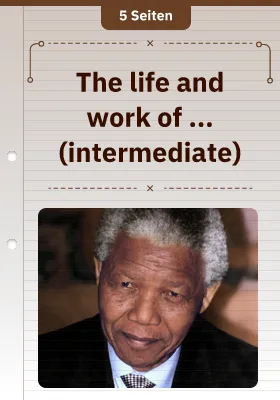
The life and work of ...(intermediate)
Learners acquire knowledge about the life and work of a selected person from history.
Content and methodology: Learners read a basic text and are able to answer comprehension questions based on this and place the life and work of the person in the context of society as a whole.
Competences:
- Reflection and discussion of the relevance of the selected person
Level: Upper school (11th - 13th grade)
Fetching more worksheets...
Next Page