

Countdown to Summer
9

Focus on women
6
Mediation
6
English
Filters
Worksheets
Mission: The Lost Punctuation Marks
This worksheet aims to teach students the fundamental rules of English punctuation through a series of "detective missions". It focuses on the correct application of end marks, commas in lists, and colons to improve overall writing clarity and sentence structure.
Content and Methods: The worksheet employs a gamified "detective headquarters" theme to guide students through three targeted exercises and one comprehensive final task. It uses fill-in-the-blank sentences for end punctuation, identification tasks for commas and colons, and a final proofreading exercise where students must rewrite a continuous text by applying punctuation and capitalization correctly. A "cheat sheet" is provided to support independent learning and rule reinforcement.
Competencies:
- Punctuation Proficiency: Correct use of periods, question marks, exclamation marks, commas, and colons
- Grammar and Mechanics: Application of capitalization rules in context
- Proofreading and Editing: Identifying missing structural cues in unpunctuated text
- Syntactic Awareness: Recognizing list structures and introductory elements in sentences
Target Group: Grade 3 and above
Jigsaw Activity: Philosophers and their Theories
Objectives
The goal is to learn the Jigsaw method as a way to independently explore complex philosophical models of thought. Participants engage objectively and critically with fundamental questions of existence and evaluate them through academic discussion. The sample content serves as a flexible template for systematic method training.
Content and Methods
This Worksheet uses a cooperative Jigsaw structure to explore core philosophical ideas. After an individual specialization phase, students deepen their knowledge in expert groups and then share it in home groups. Results are organized in a table that highlights major works and key theses. A short, fictional role-play at the end places each position in a contemporary context. All content choices - both the selection of philosophers and the theories - are designed to be interchangeable.
Competencies
- Subject Knowledge: Understanding central philosophical movements and the ability to concisely summarize complex models of thought.
- Methodological Skills: Confident use of the Jigsaw method as a cooperative learning approach and proficiency in focused academic research.
- Critical Judgment: Objective engagement with differing worldviews and their relevance for contemporary epistemology.
- Social and Communication Skills: Responsible peer-to-peer knowledge sharing and facilitation of perspective-taking through role-play.
Target Group and Level
Middle and upper secondary
Jigsaw activity: Authors and literary periods
Objectives: The primary goal is to master the Jigsaw Classroom technique as a cooperative method for exploring literary periods and their representatives. By specializing in specific sub-topics followed by a collaborative exchange of information, participants develop a profound understanding of historical eras. The selected period and authors serve as a versatile model for this methodological training.
Content and Methods: This worksheet utilizes a cooperative Jigsaw approach to decode literary characteristics. After an initial specialization phase using information cards, learners deepen their expertise in expert groups before teaching their findings within their home groups. The results are systematized in a comparative table covering biographical data and recurring motifs. The lesson concludes with a creative role-play that applies historical perspectives to contemporary societal debates. The specific literary content is designed to be an interchangeable foundation for this methodological training.
Competencies:
- Methodological Competence: Mastery of the Jigsaw technique as a learning and teaching strategy, alongside the ability to conduct targeted literary research.
- Subject-Specific Competence: Analysis of period-specific motifs, linguistic nuances, and key biographical milestones of influential writers.
- Social Competence: Assuming responsibility for the group's collective success through effective knowledge transfer and cooperative problem-solving.
- Communication Competence: Presenting complex subject matter in a peer-to-peer setting and conducting perspective-driven role-plays.
- Analytical Competence: Systematic comparison of diverse artistic approaches within a shared historical framework.
Target Group and Level:
Middle & Upper Secondary Education

Why am I even watching...?
Learning objective
The overarching learning goal is for students to reflect on their own media consumption and critically analyse the psychological functions of films and genres. Students should identify the primary needs and desires their consumption satisfies and consider how this consumption compensates for real-life deficits (the Gap Hypothesis).
Content and methods
The worksheet uses any chosen genre as a central case study. Content includes the psychological incentives (such as escapism or a desire for security), the effects of formal patterns, and critical aspects (for example, unrealistic expectations). Methods are:
- Individual inventory (“Personal Seismogram”) of the preferred genre and the primary needs it addresses
- Text analysis of the chosen genre, followed by research and brief explanations of unfamiliar terms
- Partner work to reflect on the function of consumption (distance versus closeness to reality)
- Hypothesis formation (the Gap Hypothesis), where students propose how their consumption compensates for everyday deficits
Competencies
- Self-reflection: Analyse personal media consumption and the psychological needs behind it
- Text and research skills: Understand complex psychological relationships in texts and explain key terms in the genre’s context
- Critical thinking: Distinguish between the genre’s idealised depictions and real-life situations
Target group and level
Upper secondary educators and students
How to ... Work with memes
The worksheet provides students with basic information about memes, their characteristics, their popularity, and how they function in online communication. It encourages the analysis and interpretation of memes as well as creative engagement with this medium.
Content and methods: The worksheet covers the definition of memes, their typical characteristics, the reasons for their popularity, and their role in online communication. Multiple-choice questions are used to test understanding, open-ended questions are used to analyze a specific meme, and a creative assignment is used to create students' own memes.
Skills:
- Subject-specific skills
- Analytical skills: Students learn to analyze and interpret memes.
- Creativity: Students are encouraged to create their own memes.
- Media literacy: Students reflect on the meaning and impact of memes as part of digital culture.
Target group and level: Grade 8 and above
Colonialism and its consequences (Learning Stations)
Learners gain an understanding of the consequences of colonialism by focusing on various aspects of a selected (former) colonised nation.
Content and methodology: Learners begin by examining a photograph related to colonialism. Based on this, they acquire basic knowledge about the concept and circumstances. The individual focal points of the station work are: history of a colony, social consequences, political consequences and colonialism in the present day. Based on these focal points, learners acquire comprehensive knowledge about the consequences of colonialism and its effects on the perception and living environment of a selected (formerly) colonised nation.
Competencies:
- Explaining and examining one's own and others' value orientations
- Reconstructing historical facts (reconstruction)
- Explaining the effects of political, economic and social structures and processes on people's lives and experiences
Target group and level: 8th - 10th grade
Note: Due to the volume, creation takes longer.
Resistance during National Socialism
Learners develop an understanding of the conditions and motivations of resistance groups and resistance fighters against National Socialism.
Content and methodology: Using a selected example, learners can explain everyday life under the Nazi dictatorship between consent, oppression and resistance, and assess the effects on the stability of Nazi rule.
Competencies:
- Recognise the possibilities and limitations of individual and collective action in historical situations and discuss alternative courses of action.
- Analyse historical facts in their context (multicausality).
- Reconstruct historical facts (reconstruction).
Target group and level: 9th/10th grade
Letters to my future self
Learners reflect on their current life situation, their wishes and goals, and formulate these in a letter to their future selves in order to create awareness of their own development.
Contents and methods:
The worksheet provides structured guidance on writing a personal letter to one's future self. Guiding questions serve as inspiration. The method is supplemented by the creation of a time capsule, in which small personal items such as photos or notes are enclosed with the letter.
Skills:
- Self-reflection and introspection
- Formulation of personal and professional goals
- Creative and written expression
Target group and level:
Grade 5 and above
AI through the Science-Fiction lens: what we can learn from Sci-Fi
Students analyze artificial intelligence in a work of science-fiction to understand how science fiction reflects societal values, fears, and hopes about technology and humanity. The overarching goal is to encourage critical reflection on ethical and philosophical questions surrounding AI and its implications for the future.
Content and Methods:
The worksheet guides students through a multi-step exploration of a work of science-fiction, including:
- Comprehension and analysis of the film’s or novel's plot and themes.
- Multiple-choice interpretation of key ethical, philosophical, and symbolic elements.
- Historical contextualization of the film’s creation and its relevance to early 21st-century technology.
- Open-ended reflection or essay tasks requiring students to explore ethical frameworks (e.g., utilitarianism, deontology, virtue ethics) or develop AI policy proposals.
- Methods include analytical reading, critical discussion, and creative or argumentative writing.
Competencies:
- Critical analysis of media and literature in relation to societal and ethical questions
- Understanding and application of philosophical frameworks
- Ethical reasoning and argumentation
- Historical contextualization of technological developments
- Reflective and analytical writing skills
Target Group and Level:
Grade 10 and up

AI in Science Fiction vs Now
Students explore how artificial intelligence is portrayed in science fiction compared to real-world AI today, developing an understanding of the ethical, social, and technological implications of AI through analysis and creative application.
Content and Methods:
The worksheet focuses on comparing AI in a work of Science-Fiction with present-day AI developments. Students analyze AI capabilities, goals, human–AI interactions, and societal responses. Methods include guided comparative research, critical questioning, and a creative design task where students create a movie poster for a fictional AI sequel that connects science fiction themes with current realities.
Competencies:
- Analytical thinking and critical comparison of fictional and real-world AI
- Understanding ethical and social implications of AI technologies
- Creative transfer and visual communication through media design
- Reflection on human–machine relationships and societal impact
Target Group and Level:
Grades 9 and up.
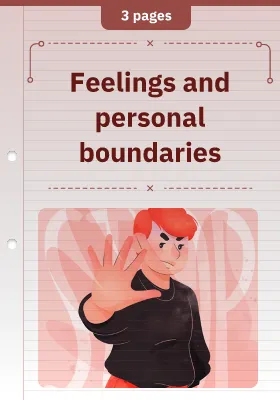
Feelings and personal boundaries
The learners should develop an awareness of their own feelings and personal boundaries. The goal is to teach them to distinguish between good and bad touches, define their personal space, and learn appropriate responses in uncomfortable situations.
Content and Methods:
The worksheet begins with a "Feelings barometer," where students evaluate touch situations using emojis. Next, the concept of "personal space" is introduced, which learners will illustrate and define who may enter it. A text about an uncomfortable situation serves as a basis for partner work to reflect on feelings and reactions. A table for categorizing characteristics of "good" and "bad" touches, along with group work to gather examples, deepens understanding. Methods include self-assessment, creative design, text analysis, partner and group work, and categorization exercises.
Competencies:
- Recognizing and naming personal feelings related to touch
- Defining and communicating personal boundaries
- Distinguishing between acceptable and uncomfortable touches
- Reflecting on behaviors in potentially uncomfortable situations
- Collaboration and communication in partner and group work
Target Group and Level:
Grade 3 and up
Note:
Worksheet 2 from the worksheet series "My Body Belongs to Me."
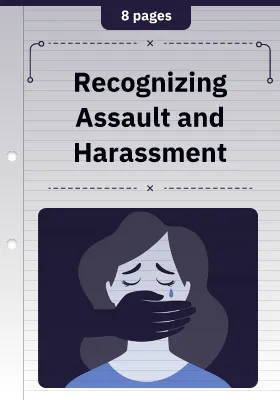
Recognizing Assault and Harassment
Students will develop an awareness of assault and harassment, understand the differences between these concepts, and learn how to respond appropriately, both as individuals affected and as witnesses. The goal is to enhance their ability to defend themselves, set boundaries, and support others.
Content and Methods:
The worksheet defines "harassment" and "assault" and encourages students to find examples. A text on a selected topic serves as a case study to explain sexual harassment and discuss its impacts. Questions and a multiple-choice task deepen understanding. A word puzzle highlights the short- and long-term consequences of assaults. In partner work, students explore how to intervene as witnesses and why it's important not to look away. A final reflection focuses on the role of consent. Methods include text analysis, brainstorming, partner work, multiple-choice tasks, word puzzles, and reflection.
Competencies:
- Distinguishing between harassment and assault
- Recognizing and identifying problematic behavior
- Analyzing the impacts of assault and harassment
- Developing strategies for action as victims and witnesses
- Understanding the importance of consent and the right to say "no"
- Collaboration and reflection in groups
Target Group and Level:
Grade 7 and up
Fetching more worksheets...
Next Page