

Countdown to Summer
9

Focus on women
6

Mediation
6
non-subject specific content
Filters
Worksheets
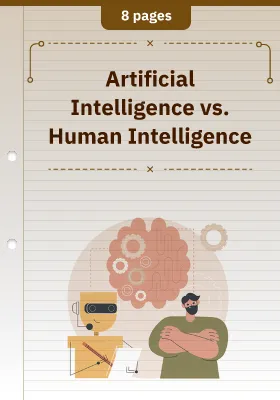
Artificial Intelligence vs. Human Intelligence
This worksheet aims to provide a comprehensive comparison between artificial and human intelligence, specifically focusing on the mechanisms of creativity and memory. It encourages students to critically evaluate the strengths and limitations of AI while reflecting on the unique qualities of human thought and emotion.
Content and methods: The worksheet employs a variety of pedagogical approaches, including comparative tables for self-assessment, creative writing prompts, and reflective questions based on personal experience. It integrates technical texts and a video lesson to explain AI learning models (supervised, unsupervised, and reinforcement learning) and human memory types (episodic, emotional, semantic, and sensory). The material concludes with a case study on AI in a professional field and a group discussion to synthesize the ethical and social implications of human-AI collaboration.
Competencies:
- Analytical thinking: Comparing cognitive processes between machines and humans
- Media literacy: Understanding different machine learning methods and AI data sources
- Reading and audiovisual comprehension: Extracting information from specialized texts and video content
- Creative and reflective writing: Producing original content and analyzing one's own creative influences
- Ethical evaluation: Discussing the impact of AI on society, trust, and professional fields
Target group: Grade 9 and above
AI addiction
Objective: The worksheet serves to educate students about the growing phenomenon of artificial intelligence addiction. Students should be made aware of the line between helpful support and compulsive use, reflect on their own behavior, and develop strategies for a healthy balance.
Content and methods: The content covers the concept of AI addiction, typical characteristics of dependency such as loss of control, tolerance development, and withdrawal symptoms, as well as psychological and neurobiological causes. This is supplemented by case studies on problematic and risky use, opportunities and risks of intensive AI application, and strategies for prevention and healthy use in everyday life. The methods include self-tests and self-assessments of one's own usage behavior, explanatory information texts, comparative case analyses, structured reflection phases on warning signs and possible courses of action, as well as creative transfer tasks such as designing rule posters with dos and don'ts.
Competencies:
- Self-reflection skills: Ability to critically evaluate one's own digital usage behavior
- Analytical skills: Identification of psychological warning signs and long-term social consequences of addiction
- Action skills: Development of usage rules and solutions for regaining self-control
- Health competence: Understanding the effects of AI on emotion regulation and general well-being
Target group and level: From grade 8 onwards
What is artificial intelligence and how does it work? (Upper secondary level)
Objective: This worksheet provides an in-depth understanding of the technical fundamentals and ethical implications of artificial intelligence at the upper secondary level. The aim is to go beyond mere application and understand the underlying mechanisms (such as neural networks and machine learning) and critically reflect on their social implications.
Content and methods: The content covers fundamental technical concepts of artificial intelligence such as machine learning, deep learning, and neural networks, the distinction between weak and strong AI, and the analysis of everyday digital applications according to criteria such as data volume, algorithms, and learning ability. This is supplemented by practical case studies on personalized learning systems and ethical and social issues such as bias, responsibility, and the impact on learning and creativity. The methods include technical term explanations, comparative classification tasks, scenario-based case analyses, multi-perspective role-plays from different points of interest, and stimulating discussion and position exercises in the classroom, in which learners justify and reflect on their attitudes.
Competencies:
- Technical expertise: Confident use of technical terms such as algorithms, training data, and artificial neurons.
- Analytical skills: Ability to identify the role of training data and bias in AI models.
- Ethical judgment: Reflection on data protection and discrimination risks.
- Discussion and argumentation skills: Ability to represent complex positions within a role-play and in a plenary discussion
Target group and level: From grade 10 onwards
What is artificial intelligence and how does it work? (Intermediate level)
Objective: The worksheet provides a basic understanding of how artificial intelligence (AI) works at an intermediate level. Learners should be able to distinguish AI applications from classic programs, understand the technical learning process, and critically question algorithms in everyday life.
Content and methods: The content covers the basic definition of artificial intelligence, the distinction between static programs and adaptive systems, the three-step model of how AI works (data collection, pattern recognition, application), and the opportunities and risks of recommendation algorithms, such as filter bubbles and data bias. This is supplemented by practical case studies and the transfer of knowledge to school application scenarios. The methods include explanatory text work, tabular classifications, visual process diagrams to illustrate technical processes, analytical case studies, and creative transfer tasks in which learners take on developer roles to design their own AI ideas for everyday life.
Competencies:
- Technical understanding: Understanding the logic of algorithms and machine learning
- Judgment: Reflection on the limitations and error susceptibility of AI systems
- Design skills: Development of innovative solutions for one's own environment (school)
- Analytical skills: Distinguishing between different phases of the learning process using practical examples
Target group and level: From grade 8 onwards
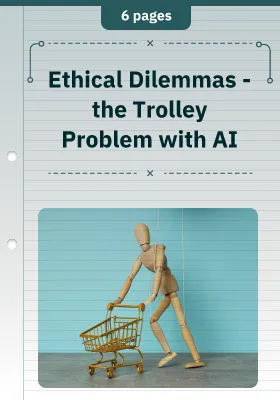
Ethical Dilemmas - the Trolley Problem with AI
This worksheet aims to introduce students to the "trolley problem" as a fundamental ethical dilemma, encouraging them to evaluate moral decision-making through the lens of different philosophical theories and their modern application in artificial intelligence and autonomous driving.
Content and methods: The worksheet uses a multimedia approach, starting with a video-based discussion of the trolley scenario. It then provides informative texts on utilitarianism, deontology, virtue ethics, and moral relativism to facilitate theoretical understanding. Students apply these concepts through comprehension questions, analytical writing tasks, and a creative "pitch" presentation where they role-play as programmers to address the ethical challenges of self-driving cars.
Competencies:
- Ethical reasoning and moral judgment
- Application of philosophical theories to modern technology
- Critical thinking and perspective-taking
- Argumentation and presentation skills
- Reading and media literacy
Target group: Grade 10 and above

Jigsaw Activity: Philosophers and their Theories
Objectives
The goal is to learn the Jigsaw method as a way to independently explore complex philosophical models of thought. Participants engage objectively and critically with fundamental questions of existence and evaluate them through academic discussion. The sample content serves as a flexible template for systematic method training.
Content and Methods
This Worksheet uses a cooperative Jigsaw structure to explore core philosophical ideas. After an individual specialization phase, students deepen their knowledge in expert groups and then share it in home groups. Results are organized in a table that highlights major works and key theses. A short, fictional role-play at the end places each position in a contemporary context. All content choices - both the selection of philosophers and the theories - are designed to be interchangeable.
Competencies
- Subject Knowledge: Understanding central philosophical movements and the ability to concisely summarize complex models of thought.
- Methodological Skills: Confident use of the Jigsaw method as a cooperative learning approach and proficiency in focused academic research.
- Critical Judgment: Objective engagement with differing worldviews and their relevance for contemporary epistemology.
- Social and Communication Skills: Responsible peer-to-peer knowledge sharing and facilitation of perspective-taking through role-play.
Target Group and Level
Middle and upper secondary

Why am I even watching...?
Learning objective
The overarching learning goal is for students to reflect on their own media consumption and critically analyse the psychological functions of films and genres. Students should identify the primary needs and desires their consumption satisfies and consider how this consumption compensates for real-life deficits (the Gap Hypothesis).
Content and methods
The worksheet uses any chosen genre as a central case study. Content includes the psychological incentives (such as escapism or a desire for security), the effects of formal patterns, and critical aspects (for example, unrealistic expectations). Methods are:
- Individual inventory (“Personal Seismogram”) of the preferred genre and the primary needs it addresses
- Text analysis of the chosen genre, followed by research and brief explanations of unfamiliar terms
- Partner work to reflect on the function of consumption (distance versus closeness to reality)
- Hypothesis formation (the Gap Hypothesis), where students propose how their consumption compensates for everyday deficits
Competencies
- Self-reflection: Analyse personal media consumption and the psychological needs behind it
- Text and research skills: Understand complex psychological relationships in texts and explain key terms in the genre’s context
- Critical thinking: Distinguish between the genre’s idealised depictions and real-life situations
Target group and level
Upper secondary educators and students
Phishing and fraud with AI
Objective: The worksheet serves to educate learners about cyber fraud, particularly phishing and the use of artificial intelligence. The aim is for learners to recognize fraudulent intentions in digital messages, understand how AI-supported attacks work, and learn effective prevention and immediate measures.
Content and methods: The content covers the recognition and classification of phishing attempts, typical characteristics of fake websites and messages, the influence of AI on the professionalization of digital scams, and strategies for prevention and correct action in the event of fraud. This is supplemented by an examination of language, image, and audio clues, as well as a critical evaluation of digital forms of communication. The methods include visual website analysis, structured information and text work, audio evaluations, action-oriented prevention exercises, and cooperative group work in which participants create their own sample messages and then reflect on and review them together.
Competencies:
- Media and information literacy: Recognizing psychological manipulation and technical obfuscation in digital media
- Analytical skills: Identifying warning signs in text and audio messages
- Action competence: Deriving and applying security rules for the digital space
- Critical thinking: Developing a healthy skepticism toward unexpected requests to disclose personal data
Target group and level: Grade 10 and above
AI and Accessibility
Objective: The worksheet raises learners' awareness of the potential of artificial intelligence to promote inclusion and accessibility. The aim is to understand how technological assistance systems can increase the independence of people with disabilities in everyday life.
Content and methods: The content includes an introduction to AI-supported assistance functions for people with disabilities, basic knowledge about this form of disability, typical barriers in everyday life, and ethical issues relating to data protection, accessibility, and the relationship between human and technical support. This is supplemented by practical case studies and the development of students' own app ideas as an application of what they have learned. The methods include the assignment and analysis of specific AI functions, theoretical impulses with hypothesis formation, empathic role-playing, scenario-based case work, creative project work on app design, and structured reflection and discussion phases on ethical aspects.
Competencies:
- Perspective taking: Developing empathy for the realities of life for people with disabilities
- Media and technology skills: Recognizing AI as a tool for assistive technologies
- Problem-solving skills: Transferring technological knowledge to complex everyday obstacles
- Ethical judgment: Critical examination of social conditions
Target group and level: Grade 8 and above
Areas of application for AI in the workplace
Objective: The worksheet aims to educate learners about the use of artificial intelligence in medical diagnostics. Learners should understand how AI systems support professionals, increase efficiency, and what ethical questions arise regarding responsibility and trust.
Contents and methods: The content includes an introduction to AI-supported imaging based on informational texts, analysis tables on areas of application, a practical case study, and an overview of the pros and cons of opportunities and risks. Methodologically, the content is taught through a combination of technical text work, structured analysis, case studies, and reflective exchange formats such as opinion rounds and evaluation surveys.
Competencies:
- Technical competence: Understanding how AI works in medical imaging and diagnostics.
- Ethical reflection competence: Critical examination of the question of who bears ultimate responsibility for AI-supported wrong decisions.
- Assessment competence: Weighing up the opportunities and challenges of technological innovations.
Target group and level: From grade 10 onwards.
Protecting personal data when using AI
Objective: The worksheet raises learners' awareness of protecting their privacy when using artificial intelligence. The aim is to develop a deep understanding of what “personal data” is, the risks involved in sharing it, and how to protect oneself from misuse through targeted security rules.
Content and methods: The content includes an age-appropriate introduction to sensitive personal data, the risks involved in the digital space, and the conscious use of passwords, apps, and one's own digital footprint. This is supplemented by case studies on data misuse and the development of specific security rules for everyday life. Methods include visual image analysis, multiple-choice tasks to consolidate knowledge, active categorization exercises, scenario-based case studies, and creative group work such as designing security posters to promote reflection and decision-making skills.
Competencies:
- Media literacy: Developing an awareness of one's “digital footprint” and protecting one's identity online
- Risk perception: Ability to recognize potential dangers such as identity theft or unauthorized data transfer via apps
- Action competence: Formulation and application of practical safety rules for everyday digital life
- Critical thinking: Questioning the trustworthiness of applications, even if they promise useful functions
Target group and level: From grade 7 and above
How to ... Work with memes
The worksheet provides students with basic information about memes, their characteristics, their popularity, and how they function in online communication. It encourages the analysis and interpretation of memes as well as creative engagement with this medium.
Content and methods: The worksheet covers the definition of memes, their typical characteristics, the reasons for their popularity, and their role in online communication. Multiple-choice questions are used to test understanding, open-ended questions are used to analyze a specific meme, and a creative assignment is used to create students' own memes.
Skills:
- Subject-specific skills
- Analytical skills: Students learn to analyze and interpret memes.
- Creativity: Students are encouraged to create their own memes.
- Media literacy: Students reflect on the meaning and impact of memes as part of digital culture.
Target group and level: Grade 8 and above
Fetching more worksheets...
Next Page