

Countdown to Summer
9

Focus on women
6
Mediation
6
History
Filters
Worksheets
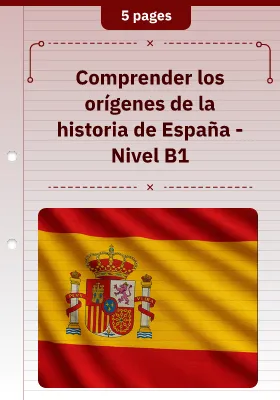
Comprender los orígenes de la historia de España - Nivel B1
Objective: This worksheet aims to provide learners with a basic understanding of Spanish history and to practice their written communication skills.
Content and Methods: It covers the origins and key periods of Spanish history, including historical facts and a fictional letter from the past. Methods include listening and reading comprehension, multiple-choice and true/false questions, and a letter-writing task.
Competencies:
- Listening and reading comprehension
- Historical knowledge of Spain
- Written communication
Target audience and level: Spanish learners at B1 level
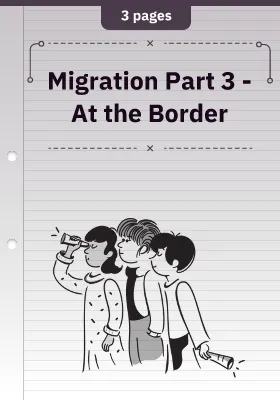
Migration Part 3 - At the Border
This worksheet aims to provide students with a multifaceted understanding of the historical and emotional complexities of immigration at a border. By combining historical facts with empathetic role-playing, students explore the challenges, legal hurdles, and personal stakes involved in seeking a new life.
Content and methods: The worksheet utilizes a blend of historical reading, audio-based interaction, and creative writing. It provides a text on a country's immigration policies to establish historical context. Methodologically, it shifts from factual comprehension to perspective-taking by prompting students to listen to border official questions, write a reflective essay from the viewpoint of an immigrant, and analyze the internal emotional landscape of those facing interrogation.
Competencies:
- Historical Literacy: Understanding historical immigration laws
- Empathy and Perspective-Taking: Analyzing the emotional burden and fears of immigrants during the entry process
- Listening and Writing Skills: Processing oral questions and articulating detailed personal narratives in an essay format
- Critical Reflection: Evaluating the consequences of refusal and the ethical implications of national allegiance and bias
Target group: Grades 9-12 (High School)
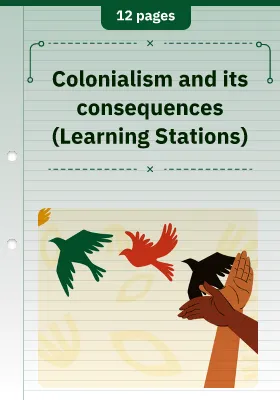
Colonialism and its consequences (Learning Stations)
Learners gain an understanding of the consequences of colonialism by focusing on various aspects of a selected (former) colonised nation.
Content and methodology: Learners begin by examining a photograph related to colonialism. Based on this, they acquire basic knowledge about the concept and circumstances. The individual focal points of the station work are: history of a colony, social consequences, political consequences and colonialism in the present day. Based on these focal points, learners acquire comprehensive knowledge about the consequences of colonialism and its effects on the perception and living environment of a selected (formerly) colonised nation.
Competencies:
- Explaining and examining one's own and others' value orientations
- Reconstructing historical facts (reconstruction)
- Explaining the effects of political, economic and social structures and processes on people's lives and experiences
Target group and level: 8th - 10th grade
Note: Due to the volume, creation takes longer.
Resistance during National Socialism
Learners develop an understanding of the conditions and motivations of resistance groups and resistance fighters against National Socialism.
Content and methodology: Using a selected example, learners can explain everyday life under the Nazi dictatorship between consent, oppression and resistance, and assess the effects on the stability of Nazi rule.
Competencies:
- Recognise the possibilities and limitations of individual and collective action in historical situations and discuss alternative courses of action.
- Analyse historical facts in their context (multicausality).
- Reconstruct historical facts (reconstruction).
Target group and level: 9th/10th grade
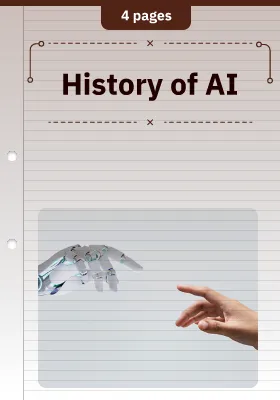
History of AI
Students explore the origins of artificial intelligence (AI) and examine one stage of its development in detail.
Methods and content: The worksheet begins with the historical and philosophical roots of the idea of AI. Text analysis and multiple-choice questions are used to explore the philosophical foundations laid by René Descartes and Gottfried Wilhelm Leibniz. In the second part, practical developments are examined on the basis of a selected event. This involves analysing an audio source and completing transfer tasks. Finally, as an optional extra, a chronological sorting task can be completed as part of a video analysis to classify important historical milestones.
Skills:
- Critical thinking: Analysis of philosophical arguments and answering multiple-choice questions.
- Media literacy: Use of audio and video sources to obtain and summarise information.
- Transfer skills: Transferring historical observations to modern AI applications and evaluating their significance today.
Target group and level: From Year 7 onwards.
Films in the classroom: Brochure
With the help of the worksheet, learners engage with a film in a structured way in order to develop a deeper understanding and to reflect on and transfer what they have seen.
Contents and methods:
The worksheet is structured like a brochure and asks questions about the content and further questions about the film. The worksheet ends with a personal evaluation of the film.
Skills:
- Concentrated extraction of information from a visual medium
- Analysis, reflection and transfer of film content
Target group and level:
Grade 7 and above
Films in the classroom
With the help of the worksheet, learners engage with the content of a film in a structured manner before, during and after viewing it in order to develop a deeper understanding and to reflect on and transfer what they have seen.
Content and methods:
The worksheet begins by testing prior knowledge of the film. While watching, the pupils complete multiple-choice tasks to actively engage with and consolidate their understanding. After the film, transfer tasks are used for further processing and reflection on the topic.
Skills:
- Activating and building on prior knowledge
- Concentrated extraction of information from a visual medium
- Analysis, reflection and transfer of film content
Target group and level:
Grade 7 and above
Working with Diagrams & Statistics
The students practice reading a diagram and extracting information from it.
Contents and methods:
The students will first answer guided questions about the shown diagram. Afterwards they will analyze the diagram in more detail.
Skills:
- Reading charts and diagrams
- Extracting information from charts and diagrams
- Analyzing charts and diagrams
Target group:
Grade 8 and above
Contemporaries in history - Who lived with whom?
Learners develop an understanding of a chosen period and the people who lived at that time.
Content and method: Using role cards, learners deal with three different historical figures from the same period. In doing so, they learn more about differences and similarities as well as their role in history. The worksheet is intended to provide a better overview of history in order to make interdependencies visible.
Competencies:
- compare and evaluate their own culture with other cultures in terms of their historical conditionality
- Recognize the possibilities and limits of individual and collective action in historical situations
- Analyze historical facts in their interdependencies (multi-causality)
Level: Intermediate
The Second World War
Learners can explain a selected event in the context of the Second World War and categorize it in the overall context of the war.
Content and methodology: Using various texts and audio messages, learners work through the most important information in the context of the Second World War. They focus specifically on one event during the war and receive information about the time before the war and the consequences in the post-war period. The learners summarize this information in a final essay task.
Competences:
- Analyse historical facts in their causal contexts (multi-causality)
- Reconstruct historical facts (reconstruction)
- Characterise and evaluate the Second World War
Level: 9th/10th grade
Basic knowledge of history (basics)
Learners acquire basic knowledge of a selected topic in history.
Content and methodology: Learners read a basic text and can answer comprehension questions based on it.
Competences:
- Promote reading skills
- Deepen historical knowledge
Level: Grades 5 - 7
Basic knowledge of history (intermediate level)
Learners acquire basic knowledge of a selected historical topic.
Content and methodology: Learners read a basic text and are able to answer historical comprehension questions based on it.
Competences:
- Promoting reading skills
- Assessing and explaining historical contexts
Level: Intermediate level (8th - 10th grade)
Fetching more worksheets...
Next Page