

Countdown to Summer
9

Focus on women
6

Mediation
6
Ethics
Filters
Worksheets
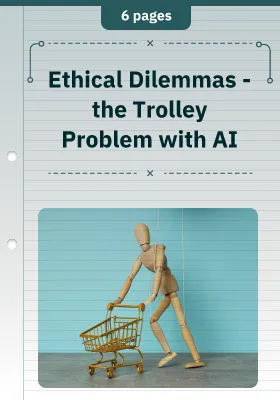
Ethical Dilemmas - the Trolley Problem with AI
This worksheet aims to introduce students to the "trolley problem" as a fundamental ethical dilemma, encouraging them to evaluate moral decision-making through the lens of different philosophical theories and their modern application in artificial intelligence and autonomous driving.
Content and methods: The worksheet uses a multimedia approach, starting with a video-based discussion of the trolley scenario. It then provides informative texts on utilitarianism, deontology, virtue ethics, and moral relativism to facilitate theoretical understanding. Students apply these concepts through comprehension questions, analytical writing tasks, and a creative "pitch" presentation where they role-play as programmers to address the ethical challenges of self-driving cars.
Competencies:
- Ethical reasoning and moral judgment
- Application of philosophical theories to modern technology
- Critical thinking and perspective-taking
- Argumentation and presentation skills
- Reading and media literacy
Target group: Grade 10 and above

Jigsaw Activity: Philosophers and their Theories
Objectives
The goal is to learn the Jigsaw method as a way to independently explore complex philosophical models of thought. Participants engage objectively and critically with fundamental questions of existence and evaluate them through academic discussion. The sample content serves as a flexible template for systematic method training.
Content and Methods
This Worksheet uses a cooperative Jigsaw structure to explore core philosophical ideas. After an individual specialization phase, students deepen their knowledge in expert groups and then share it in home groups. Results are organized in a table that highlights major works and key theses. A short, fictional role-play at the end places each position in a contemporary context. All content choices - both the selection of philosophers and the theories - are designed to be interchangeable.
Competencies
- Subject Knowledge: Understanding central philosophical movements and the ability to concisely summarize complex models of thought.
- Methodological Skills: Confident use of the Jigsaw method as a cooperative learning approach and proficiency in focused academic research.
- Critical Judgment: Objective engagement with differing worldviews and their relevance for contemporary epistemology.
- Social and Communication Skills: Responsible peer-to-peer knowledge sharing and facilitation of perspective-taking through role-play.
Target Group and Level
Middle and upper secondary
AI and Accessibility
Objective: The worksheet raises learners' awareness of the potential of artificial intelligence to promote inclusion and accessibility. The aim is to understand how technological assistance systems can increase the independence of people with disabilities in everyday life.
Content and methods: The content includes an introduction to AI-supported assistance functions for people with disabilities, basic knowledge about this form of disability, typical barriers in everyday life, and ethical issues relating to data protection, accessibility, and the relationship between human and technical support. This is supplemented by practical case studies and the development of students' own app ideas as an application of what they have learned. The methods include the assignment and analysis of specific AI functions, theoretical impulses with hypothesis formation, empathic role-playing, scenario-based case work, creative project work on app design, and structured reflection and discussion phases on ethical aspects.
Competencies:
- Perspective taking: Developing empathy for the realities of life for people with disabilities
- Media and technology skills: Recognizing AI as a tool for assistive technologies
- Problem-solving skills: Transferring technological knowledge to complex everyday obstacles
- Ethical judgment: Critical examination of social conditions
Target group and level: Grade 8 and above
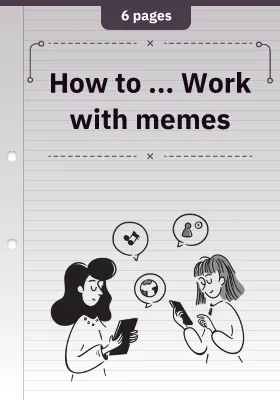
How to ... Work with memes
The worksheet provides students with basic information about memes, their characteristics, their popularity, and how they function in online communication. It encourages the analysis and interpretation of memes as well as creative engagement with this medium.
Content and methods: The worksheet covers the definition of memes, their typical characteristics, the reasons for their popularity, and their role in online communication. Multiple-choice questions are used to test understanding, open-ended questions are used to analyze a specific meme, and a creative assignment is used to create students' own memes.
Skills:
- Subject-specific skills
- Analytical skills: Students learn to analyze and interpret memes.
- Creativity: Students are encouraged to create their own memes.
- Media literacy: Students reflect on the meaning and impact of memes as part of digital culture.
Target group and level: Grade 8 and above
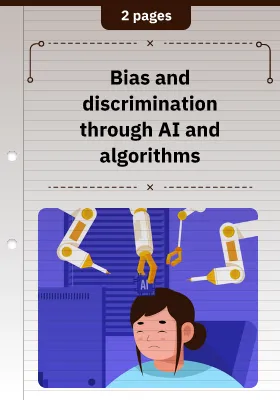
Bias and discrimination through AI and algorithms
Learners critically examine the supposed neutrality of algorithms and understand how AI systems can reproduce and cement social inequalities.
Content and methods:
The worksheet provides a theoretical introduction to the problems of machine learning and illustrates these using a case study. By analyzing factual texts and working through reflection questions, learners examine mechanisms such as the “black box problem,” proxy variables, and the ethical consequences of algorithmic decisions.
Skills:
- Recognizing bias in technical systems and questioning the objectivity of data.
- Discussing responsibility and accountability in the context of automated processes.
Target group:
Grade 11 and above.
Data capitalism – personal data as currency?
Learners analyze the concept of data capitalism, identify the economic value of personal data, and evaluate the key opportunities and risks of data trading.
Contents and methods:
The worksheet deals with data capitalism and the role of personal data as a “currency.” Using the example of the fictional character Nala, the types of data shared and their economic interest for companies are examined. The economic value of data, the role of data brokers, and the use of profiles by companies are discussed. A sorting exercise traces the flow of data from release to corporate use. Subsequently, argumentative texts highlight the perspectives of consumer representatives, business representatives, and small business owners on the opportunities and risks of data trading in order to summarize the most important arguments in a concluding table and write a reasoned statement.
Skills:
- Analysis of data flow and economic interdependencies in data capitalism.
- Assessment of the opportunities and risks of trading personal data from different perspectives.
- Reasoned statement on a socially relevant economic topic.
- Summary and structuring of complex factual texts.
Target group:
Grade 9 and above
Artificial intelligence: How does it work?
Learners critically examine the effects of AI in everyday applications on individuals and society.
Content and methods: Learners first reflect on where they encounter AI in everyday life in a mind map. This provides a good introduction to the topic. Alternatively, a video is provided that addresses AI in everyday life and can be used as a further introduction. Learners then examine an Instagram post and a newspaper article that shed light on how a selected AI application works in everyday life. Open-ended questions are provided to deepen their understanding of the content. Based on this, learners watch a video from the "kurzgesagt" on the future of artificial intelligence and society. A related assignment is given.
Skills:
- Technical expertise
- Critical reflection on AI and its everyday uses
- Global perspective
Target group and level: Grade 8 and above
AI and emotions – can AI understand emotions?
The worksheet introduces pupils to the complex interplay between human psychology, biology and modern technology. It examines how humans experience emotions and whether artificial intelligence (AI) is capable of “understanding” them.
Content and methods: Learners first explore the basics of our emotions. They then learn more about how AI works to read emotions in an informational text. Afterwards, they take a closer look at the current possibilities of AI in a video clip. In both cases, learners are given comprehension questions. Finally, learners read a diary entry about a selected emotion. The learners work out whether the text was written by AI or by a human being.
Competencies:
- Technical competence: Acquisition of specialist knowledge about biological chain reactions and technological pattern recognition
- Judgement skills: Critical reflection on the use of emotion AI in the classroom and evaluation of ethical and practical consequences
- Analytical skills: Examination of texts (diary entry) for emotional authenticity and differentiation between human language and AI-generated structures
Target group and level: 8th - 10th grade
AI future scenarios – opportunities and risks
Objective: The worksheet aims to raise learners' awareness of the opportunities and risks associated with artificial intelligence (AI). They should learn to analyze different perspectives and make critical decisions in this controversial field of the future.
Content and methods: Learners first develop their own definition of artificial intelligence and are provided with a content basis through a case study. Using tables and role analysis, they evaluate opportunities and risks as well as the perspectives of various actors. Finally, they take a reasoned position in a decision-making task and reflect in a group on rules for the responsible use of AI.
Competencies:
- Understanding AI: Defining and distinguishing between the opportunities and risks of AI.
- Changing perspectives: Analyzing complex problems from different roles and attitudes.
- Critical thinking: Weighing technological progress against ethical and social risks.
- Decision-making skills: Developing well-founded decisions in a controversial context.
Target group and level: The worksheet is aimed at students from the 8th grade onwards and is also suitable for upper secondary school.

History of AI
Students explore the origins of artificial intelligence (AI) and examine one stage of its development in detail.
Methods and content: The worksheet begins with the historical and philosophical roots of the idea of AI. Text analysis and multiple-choice questions are used to explore the philosophical foundations laid by René Descartes and Gottfried Wilhelm Leibniz. In the second part, practical developments are examined on the basis of a selected event. This involves analysing an audio source and completing transfer tasks. Finally, as an optional extra, a chronological sorting task can be completed as part of a video analysis to classify important historical milestones.
Skills:
- Critical thinking: Analysis of philosophical arguments and answering multiple-choice questions.
- Media literacy: Use of audio and video sources to obtain and summarise information.
- Transfer skills: Transferring historical observations to modern AI applications and evaluating their significance today.
Target group and level: From Year 7 onwards.
Your digital footprint
Learners should understand the concept of the digital footprint, become aware of its risks, and learn specific strategies for reducing it and protecting their online reputation.
Content and methods:
The worksheet introduces the topic of digital footprints (active/passive) and cookies and highlights the associated social and individual risks. The methods used include a video, a practical self-assessment of one's own digital footprint, analysis of a specialist text on a selected risk, and concluding tips on digital security and reducing one's footprint.
Skills:
- Acquiring and applying knowledge about active and passive digital footprints
- Critical reflection on one's own online presence and the potential risks
- Analysis of the social and individual effects of data misuse
- Implementation of practical strategies to improve digital security and protect privacy
Target group and level:
Grade 10 and above
The impact of AI on the environment
Objective: The worksheet aims to raise learners' awareness of the environmental impact of artificial intelligence (AI). It trains them to critically analyse the energy and resource consumption of data centres in order to develop strategies for the environmental sustainability of AI technology, particularly through the use of renewable energies.
Contents and methods: The worksheet begins with a warm-up on the learners' personal attitudes towards AI and climate change, followed by information about AI data centres in a selected country/city. Learners analyse advantages and environmental risks using text and cause-and-effect analyses. Methods such as group research, perspective changing and decision-making encourage reflection on sustainability and concrete measures for environmental responsibility.
Competencies:
- Sustainability awareness: Understanding the ecological footprint of digital technologies (energy and resource consumption).
- Critical analysis: Weighing technological advantages (climate research, smart farming) against environmental risks.
- Problem solving: Developing concrete strategies to promote energy efficiency and the use of green energy sources for AI.
- Understanding of roles: Making informed political decisions from an environmental policy perspective.
Target group and level: Years 8–10 (middle school)
ESD:
- 12: Responsible consumption and production patterns: This addresses the challenge of raw material extraction (rare earths) and the need for recycling and sustainable procurement.
- 13: Climate action: The text highlights the role of AI in reducing global emissions and in climate research.
Fetching more worksheets...
Next Page